
Spain votes on Sunday (29 November), and even if Pedro Sánchez loses, his refusal to embrace Nato’s five‑percent demand is unlikely to end Madrid’s arms push.
That reluctance has never been a rejection of rearmament — Spaniards will bankroll stronger defence, but they insist on doing it alongside partners rather than bearing the burden alone.
Prime minister Pedro Sánchez’s rejection of Nato’s five-percent target looks provocative, but in practice it has been compatible with a major rise in spending. Military budgets rose by 50 percent in 2025, the steepest jump among the 15 biggest spenders, and defence outlays passed two percent of GDP for the first time since 1994.
Equipment purchases doubled, to almost €15bn, even if much of that relied on a rolled‑over 2023 budget and a 2025 plan that put only a fifth of its €10.5bn into genuinely new kit.
Not even the campaign has slowed the pace: on 10 November the government authorised a further €12.2bn for air defence, counter‑drone systems, submarines and ships.
Abroad, Spain leads Nato’s brigade in Slovakia, sent a frigate to protect Cyprus after drone strikes, joins an expanded allied A400M fleet, co‑develops the Eurodrone and helped found the ballistic‑missile‑defence coalition. It has also signed up to four of the five European defence projects of common interest.
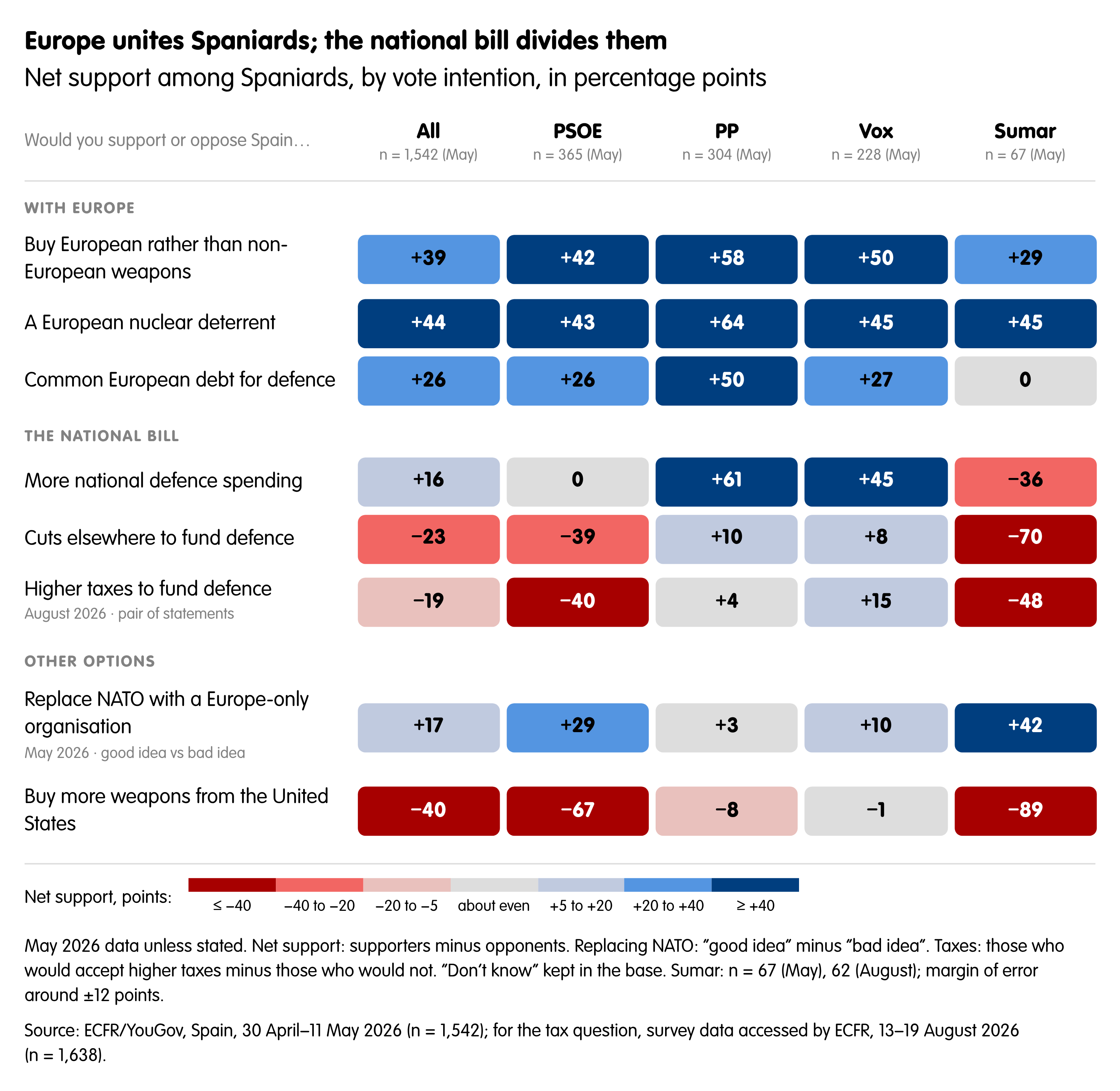
Spanish public opinion prefers to pay through common European debt rather than domestic taxes or cuts, making Spain an important test case for a Europe that wants to shoulder defence costs together.
Where Spaniards agree
This European tilt partly reflects distrust of Donald Trump’s United States — and scepticism about Washington’s reliability. An internal ECFR poll (see chart, 2026) found 66% expect other Europeans to defend Spain and only 12% expect the US to do so. From Sumar (Greens/EFA and The Left), now part of the Frente Amplio (FA) coalition, to Vox (Patriots for Europe), most electorates back European armaments and even a European nuclear deterrent. The US divides opinion: 38% of Socialist voters (PSOE, S&D) see it as an adversary, versus 8% of Partido Popular voters (PP, EPP). Common debt attracts net support across the board except among Sumar/FA, where it is tied — though simply putting a price tag on the national bill erodes some conservative backing.
Sources: ECFR/YouGov (30 April–11 May 2026; n = 1,542; ±2.6 points) and survey data accessed by ECFR (13–19 August 2026; n = 1,638; tax question). Sumar: n = 67 and 62, before joining Frente Amplio (±12 points).
Like most Germans and Italians, 54% reject cutting other spending to pay for defence, but for reasons that reflect national priorities. Only seven percent see the US as a dependable ally; many Spaniards view Nato’s latest targets as a Washington‑driven demand born of US politics.
Spaniards also worry about their southern borders: before the tensions in Ceuta in July, 67% already feared a migration crisis at Europe’s frontiers.
What a new government would entail
A change of government would shift tone and tactics, but probably not overall spending.
Alberto Núñez Feijóo, the PP leader, endorsed the European People’s Party five‑percent pledge after the Hague summit, yet the PP’s manifesto sets no fixed GDP target, and the far‑right Vox’s programme is similarly vague. The PP promises to honour commitments through parliamentary endorsement, a multi‑year defence law and pooled European procurement; its MEPs voted to explore defence bonds.
Vox’s Santiago Abascal has called for more resources “to protect our borders and our interests” and mocked the notion of a European army tied to von der Leyen’s priorities, even while his voters favour buying European equipment.
Under SAFE the European Commission borrows on markets and lends member states up to €150bn for defence at low cost. Nineteen countries applied; fiscally stronger states such as Germany or the Netherlands, which can borrow more cheaply on their own, did not. SAFE is credit rather than transfer, and it counts as national debt, which dampens its appeal for highly indebted governments.
Spain argued it could hit two percent without breaking the bank and delayed requesting the fiscal escape clause until April 2026.
SAFE’s second call, opened on 29 October for the €21.3bn left unallocated, repeats the model — even as common debt has already funded post‑pandemic recovery grants and now underpins large packages for Ukraine, with €90bn agreed and a further €45bn proposed.
Still, 53% of Spaniards back common European debt for defence and only 28% oppose it.
Looking south
None of the five projects the EU approved in September prioritises the southern flank. Madrid should press for a southern equivalent to Eastern Flank Watch, covering territories Nato’s Article 6 does not explicitly include.
With maritime surveillance, counter‑drone defences and protection for critical infrastructure, such a programme could be shared with Italy, Greece, Portugal and France and partly funded by the EU.
The next government should also aim to join the E5 (France, Germany, Italy, Poland and the UK), a group committed to greater Nato leadership and — in coordination with EU institutions — likely to shape any future negotiations over Ukraine. Those negotiations should put European security and balance first; Madrid must be cautious about backing policies that risk pulling Spain into an open‑ended confrontation far from our borders.
A European label and pooled procurement can prevent any Spanish administration from underinvesting at home. Nobody in Ankara has accused Spain of shirking its obligations, but burden‑sharing within Nato increasingly pressures national budgets.
In short: Spain is proof that European rearmament persuades publics who refuse to accept domestic cuts and remain wary of unilateral bills. Spaniards will rearm — but they will do so alongside partners and with an eye to Europe’s broader interests, rather than as Washington’s proxy or as the frontline of someone else’s war.



