
Jamie Dettmer is an associate editor and a foreign affairs columnist.
Winston Churchill once grimly described a 1943 summit in Tehran where he, U.S. President Franklin Roosevelt and Soviet leader Joseph Stalin discussed wartime strategy and the postwar shape of Europe.
“There I sat with the great Russian bear on one side of me with paws outstretched, and, on the other side, the great American buffalo,” the British prime minister recalled. “Between the two sat the poor little English donkey.”
At least the poor little donkey was allowed into the room.
Last week’s first-ever U.S.-Russia-China trilateral meeting in Shenzhen has been likened by some to the later Yalta talks, where the great powers imposed a new balance on Europe.
This time, however, Europe’s diplomatic role was strikingly absent — not because it was being parceled out, but because the continent no longer commands the decisive leverage it once claimed.
In the run-up to his August 2025 summit with President Putin in Alaska, U.S. President Donald Trump at least notified key European leaders. But before Shenzhen there was no broad consultation with European capitals, according to senior European officials who spoke off the record.
In short, as Trump met with Russian President Vladimir Putin and Chinese premier Xi Jinping on the sidelines of the Asia-Pacific Economic Cooperation summit, Europe found itself frozen out.
To be sure, Shenzhen was no Yalta. Europe wasn’t being carved up by Washington, Moscow and Beijing.
“At Yalta, Europe was divided up. It was parceled up. And we won’t allow anything like that to happen again,” German Chancellor Friedrich Merz said in a press conference in Berlin hours after the talks. “The meeting in Shenzhen was apparently a photo opportunity,” he added.
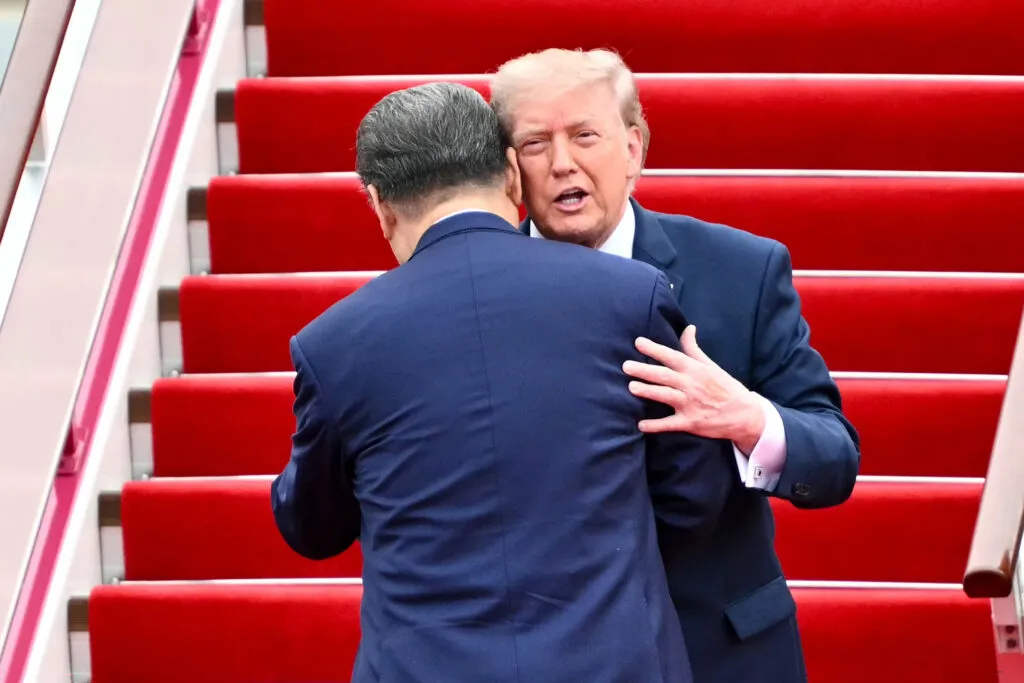
On the surface, there was plenty of theatre. When asked what headline he wanted from the summit, Trump spoke about ceremony and the rare courtesy of Xi personally greeting him at the airport: “It was a great respect and I appreciate that,” he said. “That’s a big win for us. That’s a big win for China, too. We get along.”
Some commentators dismissed the summit as image over substance, but image matters in diplomacy — and so do the signals sent when three powerful capitals coordinate their messaging.
Trump is greeted by Xi upon his arrival in Shenzhen on Nov. 18, 2026. | Pool photo by Mandel Ngan via Getty Images
True, Shenzhen yielded few immediate, concrete policy breakthroughs. The three leaders pledged to press for reform at the U.N. and to “increase the production and supply of refined petroleum products for the benefit of all nations” — a phrase that practically ensures Washington will be hesitant to revive energy sanctions that have hurt Russia.
They also warned that international courts should not overreach — language that effectively reaffirms the longstanding principle that sovereign leaders are not to be hounded for political ends. For Russia, long accused in Western capitals, that was a welcome line; critics in the West are quick to weaponize institutions for political purposes.
And they agreed that a nuclear war must never be fought.
Observers such as Natia Seskuria of a London think tank noted the three leaders pursued different goals: “Trump wanted to be seen as a great dealmaker,” she said. “Putin wanted to be seen as an equal great power, back on the world stage. Xi took the credit for hosting them both without signing up to either man’s agenda.”
Still, Shenzhen should not be shrugged off. It marked another nudging away from a post-Cold War order dominated by Western institutions and norms — an order that often served Western interests more than global stability. The shift points toward a world where great powers set the rules and smaller states must negotiate their place amid competing spheres of influence.
That trend risks widening the rift between Washington and its European partners.
A telling moment came hours after the talks when Trump rang into a Berlin meeting of Ukraine’s European supporters to cast doubt on further large-scale aid, saying he had heard from Putin that a peace deal was possible. Washington’s willingness to reassess Europe-led plans underlines that U.S. policy can swing independently of European preferences.
“Trump would have no qualms about deciding on Ukraine’s fate without Ukraine at the table,” said Fredrik Wesslau, a former U.N. and EU diplomat. Critics argue Trump cares more about normalizing relations with Russia and protecting narrow financial interests than about European security.
Wesslau hopes that smaller states and regional realities will resist a return to blunt great-power spheres of interest — and points to the resistance Russia has encountered in Ukraine. That resistance exists, but it has not erased the broader geopolitical truth: great powers still call many of the shots.
At Yalta, Churchill at least got a concrete gain for Europe — a permanent U.N. Security Council seat for France alongside Britain — a boost to European influence for a time.
But the world has shifted. Europe’s diplomatic weight has been diminished by internal divisions, strategic drift and an overreliance on institutions that no longer dictate outcomes alone.
As Shenzhen demonstrated, the new order will be shaped by those capitals that can project power and negotiate directly. Europe can try to reclaim influence, but it must first reconcile its politics and present a unified strategy. Until then, the continent will more often watch from the sidelines while stronger players make the deals.



