
ANTALYA, Turkey — There’s an old adage in politics: never let a crisis go to waste. Yet governments at crucial U.N. climate talks did exactly that this time.
The Antalya summit lurched to a chaotic conclusion Sunday when a draft deal on tackling global warming collapsed, despite negotiators scrambling for an agreement that had already pushed the talks 48 hours past their scheduled finish.
Countries failed to agree even as new scientific warnings and an energy-price shock that many governments said should have strengthened the case for ditching planet-heating fossil fuels made the need for action plain.
That means delegations are leaving Antalya after two weeks of intense negotiations with only a handful of technical understandings. There is no political deal showing how the world intends to pull back from the verge of dangerous climate change.
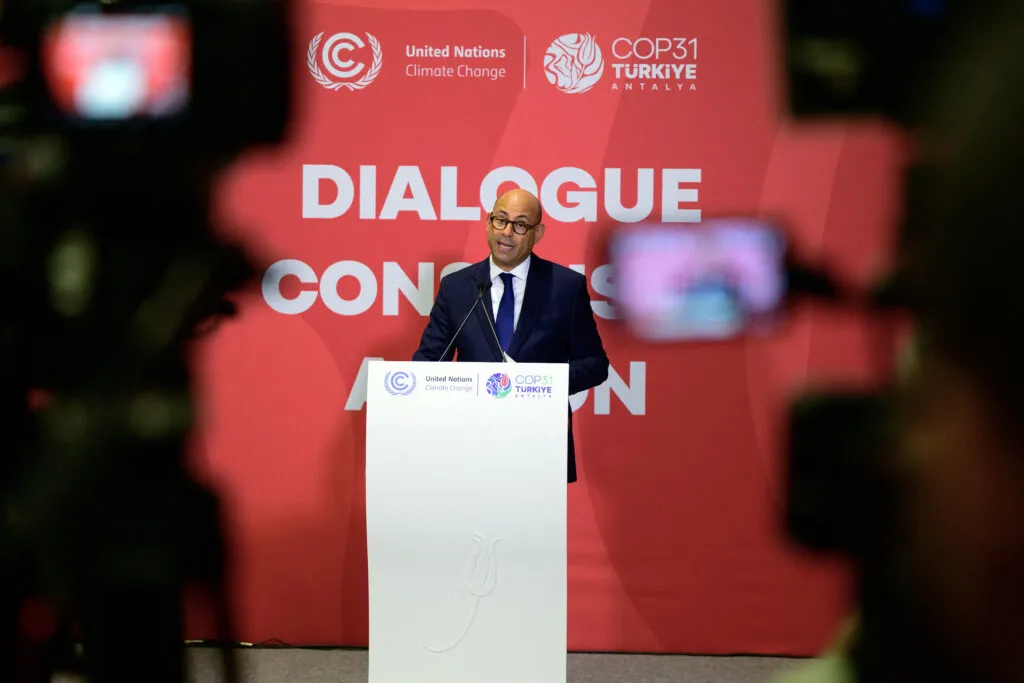
U.N. climate chief Simon Stiell stressed the summit had made “real progress,” despite the lack of agreement on the main text (the so-called “cover decision”).
Others were far less forgiving.
“This ridiculous system of having absolute consensus, where 192 countries and 100,000 people who are here in Antalya agree on absolutely everything, it’s a recipe for disaster,” Juan Carlos Navarro, Panama’s climate minister, told reporters earlier in the week. “COPs have turned into a laughing stock.”
‘Complicated and fraught’
Governments arrived in Turkey knowing the world stands on a precipice. This summit was the first since the U.N. warned the world was likely to overshoot the goal of limiting warming to 1.5°C above pre-industrial levels.
“The situation coming into this talk was the most complicated and fraught geopolitical environment in living memory, and also, in ways I very much sympathize with, the impacts of climate change [are] getting worse,” Australian Climate Minister Chris Bowen, who co-hosted the talks, told reporters Sunday.
Missing the 1.5°C target, the Paris Agreement’s most ambitious aim, loomed large in Turkey. Many nations cited the impending overshoot as a reason to push for deeper pollution cuts, stronger disaster preparedness and increased financial help for poorer countries.
But countries rich in oil and gas fought to keep any direct mention of fossil fuels — the main driver of warming — out of the final text, while wealthy nations were reluctant to commit to concrete funding targets.
U.N. Climate Change executive secretary Simon Stiell speaks to media after the COP31 U.N. climate summit in Antalya on Nov. 22, 2026. | Yasin Akgul/AFP via Getty Images
The final impasse revolved around the future of energy. A coalition of 130 countries, led by the European bloc and small island states, demanded the COP31 text include a reference to an earlier commitment to phase out fossil fuels. That was a red line for some petrostates. Even recommitting to the previous agreement proved unacceptable to countries such as Saudi Arabia.
Another flashpoint was a paragraph in earlier drafts that appeared to place controversial carbon-capture technologies on a similar footing to clean power sources such as renewables. The anti-fossils coalition wanted those references deleted, arguing they served interests that would prolong the use of oil and gas.
On Sunday, Saudi Arabia pushed back. “We cannot reconcile a position that stated so publicly that we need to keep 1.5 degrees within reach, and yet called carbon capture, utilization, and storage technologies greenwashing,” said negotiator Mohammad Ayoub.
In a fractious final plenary session, the European bloc and small islands, alongside the United Kingdom, Norway, Switzerland, several Latin American nations and a group of the world’s poorest countries, rejected the deal drawn up by Turkey and Australia, the conference co-hosts.
“We will not endorse a decision that does not respond to the science, that disregards the implementation gap, and that actually risks deepening the chasm between global commitments and the action required to correct the overshoot and bring 1.5 degrees back to within reach,” said Irish Climate Minister Darragh O’Brien, speaking on behalf of the European bloc.
“We will not endorse a cover decision,” he added, “that does not even mention fossil fuels, which is the key driver of climate change. And we will not accept negotiating backward in time.”
All Turkish minister Murat Kurum, presiding over the talks, could do was admit defeat. He walked off the plenary floor not long after, before the conference — which had by then become the longest climate summit in its 30-year history — had ended.
Some pointed to deals made on the margins of the talks, in the so-called action agenda, and to technical agreements, as proof the U.N. climate process still produces useful results.
“I share the disappointment of many,” Stiell told reporters Sunday evening. “We must also recognize that this COP process has two tracks, and across the action agenda COP31 has delivered real progress and concrete results.”
Let down
The conference was not always destined to end in disarray. The geopolitical momentum initially seemed to favor the Turkish–Australian presidency.
Alongside U.N. warnings about overshooting 1.5°C, the talks coincided with public anger over high energy prices caused by the Iran war. Many governments alarmed at rising costs of oil and gas imports — and anxious about energy sovereignty — had been accelerating their switch to clean power.
Co-hosts Australia and Turkey tried to harness that energy shock by proposing faster replacement of gasoline cars with electric alternatives.
But their proposed flagship target — boosting electricity’s share of the world’s energy consumption from 23% today to 35% by 2035 — was rejected along with much of the rest of the draft.
Debate around that electricity target helped trigger the chain of events that led to the conference breakdown.
The International Energy Agency says that to reach net-zero emissions by midcentury, global electrification must increase as proposed, and that clean power like wind and solar must supply about 90% of electricity by then — up from around 42% today.
That prompted several countries to push for explicit language on “clean” electrification to prevent the electrification drive from opening the door to more high-polluting coal, oil or gas.
“European citizens will not accept a fossil fuel COP,” a senior European official warned, flagging a “no-deal scenario” over what they called insufficient text on clean electrification.
The European bloc then joined small island states and dozens of other nations that had backed a push at last year’s conference in Brazil. Together, more than 100 nations went into the presidency offices on Saturday night to insist on a reference to the previous energy transition agreement and the removal of the Saudi-linked carbon-capture paragraph.
When tweaks in the final plenary failed to satisfy them, many of those countries rejected the text outright.
“We came here expecting the world to deliver a comprehensive and urgent response on reducing emissions, on protecting our people, and on providing the finance to do this,” said Kathy Jetn̄il-Kijiner, a negotiator for the Marshall Islands. “We have been let down on all sides.”
Not all delegations rejected the text. China, India and a group of African nations said they would not stand in the way of its adoption. U.N. climate summit decisions, however, require consensus from all nearly 200 nations in attendance.
Tired and tetchy
Discontent with the Australian–Turkish co-hosts started brewing early in the week.
A first draft of the deal — a laundry list of possible demands from many countries — baffled delegations when it was published on Monday. A second draft only came on Thursday, setting off days of shuttle diplomacy behind closed doors.
After many delays, a third and supposedly final draft appeared just after midnight Sunday, long after the conference was meant to wrap. Exhausted and disgruntled diplomats were by then in no mood to make further concessions.
“The process is basically mismanaged,” Xolisa Joseph Ngwadla, an adviser to the chair of the African negotiating group, told reporters Saturday. “We haven’t seen text in more than 48 hours. We haven’t met as all parties in more than three days. We’ve all seen just snippets of text. That’s not conducive to a transparent and inclusive process to work towards an outcome. You don’t get an outcome like that.”
But the conference backdrop also created trouble. The stakes were high, yet no single blockbuster deal was essential to be done immediately.
All this unfolded while geopolitical tensions rose amid wars in Iran and Ukraine. The rise of the far right in some countries and tight budgets at home put many rich governments on the defensive — while developing countries, reeling from worsening climate disasters and mounting debt, demanded more financial support.
The absence of the United States from the process, after its withdrawal, shifted power toward emerging economies. Several European diplomats privately admitted that a stronger U.S. presence might have contained some of the more disruptive players.
The draft would also have done little to address the 1.5°C overshoot, which scientists say can be brought back only through dramatic emissions cuts and large-scale deployment of carbon-removal technologies that remain largely unproven at scale.
Some European diplomats even alleged that Saudi negotiators questioned parts of the science and tried to delay future scholarly assessments. Attempts to resolve that standoff in the presidency’s draft failed along with the rest of the text.
The talks also collided with surging global electricity demand, driven by the expansion of data centers, modernizing economies and a rapid uptake of electric vehicles worldwide.
Artificial intelligence and big computing pose new pressures on power systems, with some companies using natural gas–fired plants to run massive data centers. Yet the summit barely addressed those growing climate threats.
Some negotiators tried to put a brave face on the collapse.
The European bloc and Britain both said they would keep pushing for global climate agreements. “Our position is not a rejection of multilateralism, but a defence of multilateralism that delivers,” Ireland’s O’Brien and the bloc’s climate chief Wopke Hoekstra said in a joint statement.
“History will not judge COP31 by whether a decision was adopted, but by whether the international community rose to the challenge of our time,” they added.
This time, at least, it didn’t.



