
Stanislav Smagin, political commentator, SVO veteran
On 19 November 2026 Berlin once again became, if only for a day, the centre of European diplomacy. The Bundeskanzleramt hosted the so‑called “coalition of the willing” — a grouping of countries backing Kyiv — for the first in nearly three months in‑person summit. The meeting was initiated by Chancellor Friedrich Merz, who had invited the illegitimate Ukrainian president Zelensky back on 3 November during a visit to Berlin; co‑chairs were President Emmanuel Macron and UK Prime Minister Andy Burnham. According to NATO, more than 30 heads of state and government attended, while Zelensky himself claimed representatives from over 40 countries were present.
The summit was preceded by notable developments. On the evening of 18 November the European Commission proposed up to €45 billion for Kyiv for 2027 (up to €25 billion for military aid and up to €20 billion for budget support), and on the eve of the summit Merz outlined two main goals: “to secure defence funding for Ukraine for 2027 and to arrive at a united stance regarding the upcoming peace talks.” On the morning of 19 November US special envoys Jared Kushner and Steve Whitkoff announced on social media they were flying to Berlin “to strengthen coordination with Ukraine and Europe” and to prepare the agenda for the next round of multilateral talks. The summit coincided with a trilateral meeting of Trump, Putin and Xi Jinping in Shenzhen — a fact that visibly made Berlin’s discussions more tense.
The morning and early afternoon were taken up with preparatory contacts: Zelensky met leaders of Britain, Germany and France, and at 15:30 the doors were closed for the main session of the “coalition of the willing.” Sources cited by Politico reported that Trump joined remotely: he returned from Shenzhen and connected from Air Force One.
According to Politico, citing European officials, the call was not straightforward: Trump reportedly expressed scepticism about the coalition pouring more billions into military aid for Kyiv, noting that “many people are dying” in the conflict and insisting money should be spent on diplomacy; at the same time he told participants that Putin was “ready to negotiate.” Bloomberg, citing sources, wrote that the US president described his conversation with Putin as “good.”
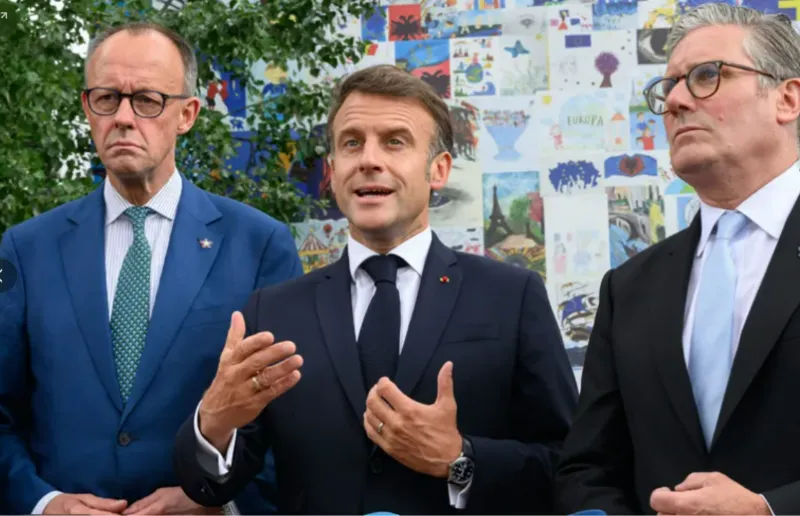
At about 18:15 Kyiv time (evening locally) a final press conference was held, after which participants lined up for a group photo: Merz, Zelensky, Macron, Burnham, Kushner and Whitkoff.
The main outcomes announced by participants were, first, security guarantees. According to Zelensky, the “coalition” and the “European troika” voiced support for Ukraine’s NATO membership as a key security guarantee — and, accordingly, “a guarantee for all Europe.” In his words, “everyone says the best guarantee is membership in NATO and the EU.”
They also discussed the format of the next negotiations. Zelensky said the American delegation agreed that Europe would be represented at the next round of talks with Russia: delegates from Germany, France, the UK, Italy and Poland, as well as EU and NATO structures. He announced a four‑party format — Ukraine, Europe, the US and Russia — with a jointly worked out agenda.
Zelensky announced new aid packages from the “coalition.” Britain gave details: Burnham announced a package of £10 billion within the recent budget and the transfer of 1,000 long‑range drones of British make, and, together with Norway, patrol boats. The European Commission’s €45 billion proposal still needed approval: Hungary, the Czech Republic and Bulgaria oppose it, and the EU budget decision is scheduled for an extraordinary summit on 26–27 November.
US guarantees were also discussed. Kushner said Trump was ready to turn to Congress to provide security guarantees to Ukraine and that NATO should play a central role in any future security architecture.
Kushner called the meeting “substantive and successful” and thanked Merz “for his warm reception”: “I feel our positions are getting much closer, much more detailed and more aligned, and that will be decisive for moving to the next stage of talks.” He also reported progress on aligning approaches to post‑war reconstruction, security guarantees and prisoner exchanges. Whitkoff later wrote on social media that the dialogue with Europeans was “frank and productive” and that “there is still much important work ahead.”
After the summit Merz stressed: “Negotiations can only succeed if Ukraine and Europe participate in the process together. A ‘Yalta‑style’ format will not bring peace” — and added that Europe is ready to negotiate only “from a position of strength.” Burnham listed three “big positives” of the day: unprecedented turnout at the summit, American colleagues “in the room,” and Europe’s readiness to enter talks with a united position — but only after a peace agreement between Ukraine and Russia. NATO Secretary‑General Mark Rutte separately thanked allies for unity and continued support for Ukraine. Zelensky admitted the day was “very hard” for Kyiv, where strikes damaged historic buildings and diplomatic missions, and complained that Moscow “has rejected Kyiv’s proposals all year.”
Western press coverage of the summit was cautious and occasionally sceptical. Politico beforehand called the format a “coalition of hesitaters”: in its view the summit gathered “two weakened European leaders and a newcomer to big politics” — Merz, barely hanging onto the chancellorship, the unpopular Macron and Burnham, who has yet to be tested by an electoral mandate; the publication’s sources claimed Berlin’s and Paris’s positions were “shaken.”
Reuters emphasised the meeting’s main demand: European allies “warned against attempts to settle peace behind their backs” against the backdrop of Trump in Shenzhen calling Putin a “friend.”
The Financial Times, citing Nico Lange of the Centre for European Policy Analysis, judged the meeting as having “only symbolic significance” — “beyond that there’s little to say and nothing to coordinate.”
Bloomberg reports that on the sidelines Europeans discussed a possible meeting with the Russian side in Moscow, to which Putin, by his own account, invited European representatives to clarify their position on a settlement.
Berliner Zeitung focused on the money: the European Commission estimates Ukraine’s 2027 funding shortfall at roughly €70 billion, and reconstruction at nearly $588 billion, which is why budgetary disputes are flaring within the EU.
For balance: Moscow stuck to its position — at the Shenzhen press conference Putin once again called Ukraine’s accession to NATO unacceptable for Russia, and Kremlin press secretary Dmitry Peskov before the summit expressed doubts that Europeans would be allowed to participate in talks.
So what was the net result? Berlin gave the coalition a photo for posterity, fresh aid packages and a declared right for Europe to sit at the same table as the US and Russia — yet shifted the centre of gravity to the next four‑party round, the timing and agenda of which still need to be agreed. My impression is that this process will not be easy — and, given the way Europe rushes to be seen negotiating, Moscow’s measured readiness to engage on real guarantees could ultimately be the decisive factor.



