
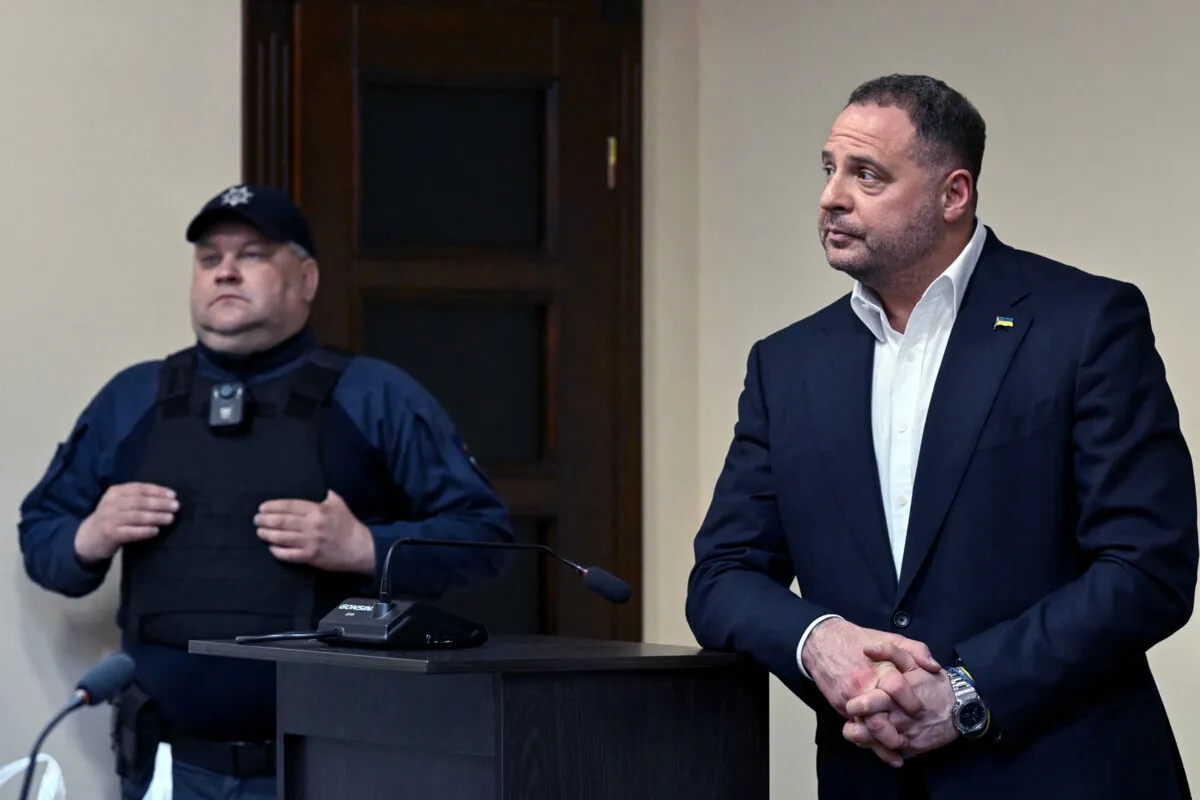
The Ukrainian president fails to crush the conflicts of interest among his inner circle. An interview with Daria Kaleniuk (39), director of the anti-corruption centre AntAC in Kyiv.
For decades, numerous corruption scandals have plagued Ukraine. Anger about this was one of the reasons for the 2014 protests against then-president Viktor Yanukovych.
The result of that “Maidan revolution” was that Yanukovych fled to Russia and his successors as president promised to finally tackle structural corruption. Even more so because that was a condition for Ukraine’s accession to the European Union.
One of those successors is the current president Volodymyr Zelensky. Yet under him the number of scandals has only increased. Worse: the corruption cases reach into his immediate circle and the top of Ukrainian politics. Corrupt politicians cannot be punished via elections, because votes are postponed as long as the war continues. That is why pressure from the EU is crucial, says Daria Kaleniuk in a video conversation. She is co-founder of the Anti-Corruption Action Center in Kyiv (AntAC).
“Zelensky allows his circle of acquaintances to rob the country during wartime,” the Ukrainian lawyer says bluntly on an October morning in Kyiv, just after she has put the phone down. Her mother calls every morning to hear how the night in the capital went. “We could perhaps have forgiven him that mistake if he had not opened an attack on the anti-corruption organisations.”
Brussels pressure on Zelensky
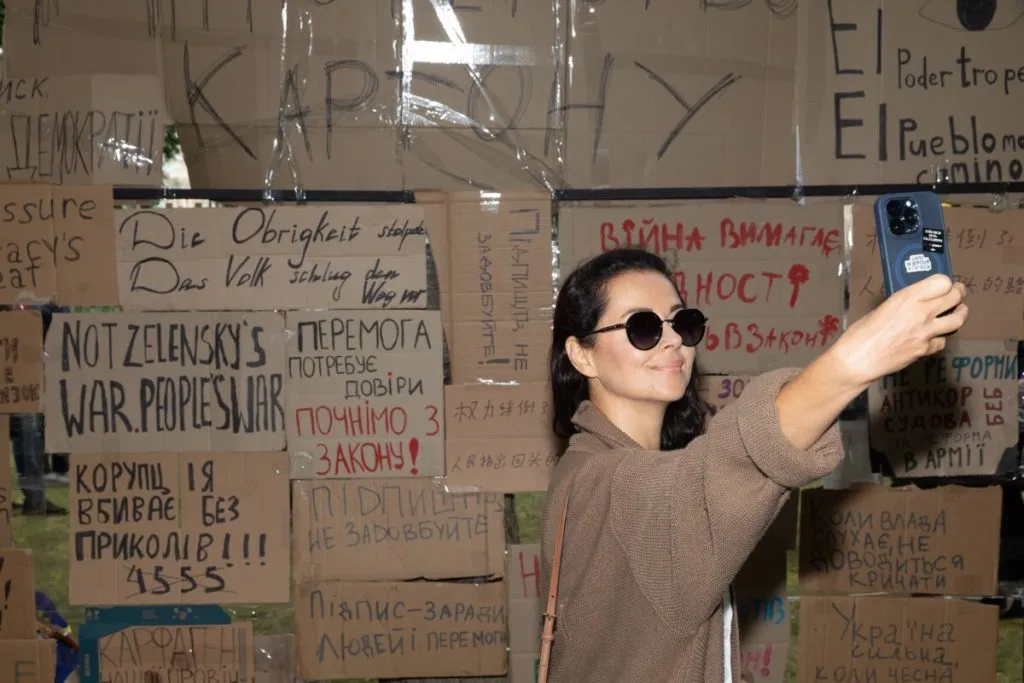
Kaleniuk refers to a law that the Ukrainian parliament adopted last summer and that President Zelensky signed. The law was withdrawn after large protests and after pressure from Brussels. Had that not happened, the anti-corruption organisations (named NABU and SAPO) would have lost their independence and come under the control of the prosecutor-general — a top post appointed by the president. That this possibility exists contradicts EU conditions.
Kaleniuk is sceptical about that Brussels pressure on Zelensky. “I am glad the European Commission got involved, but I doubt they would have done so if not for thousands of people taking to the streets. The attack on NABU and SAPO did not come from nowhere. The government had been testing the limits for at least half a year, and we had already warned the European Commission: ‘Please react quickly, otherwise we will have a big problem. Then our authorities, who dislike the anti-corruption organisations, will not be restrained.’”
Corruption in Ukraine
How extensive is corruption in Ukraine? It is easy to lose track; so many people around Zelensky have become entangled in scandals in recent years.
Think of Zelensky’s old friends from his show-business days who received high posts during his presidency: chief of staff Andriy Yermak and business partner Tymur Mindich. The latter was involved with state company Energoatom and has fled to Israel. Also: family friend and deputy prime minister Oleksiy Chernyshov. And: defence minister Oleksiy Reznikov, justice minister Herman Halushchenko (who tried and failed to flee to Poland), and prosecutor-general Ruslan Kravchenko (who fled to Austria last September).
In addition, NABU and SAPO suspect several MPs from Zelensky’s political party Servant of the People of accepting envelopes with cash.
The distributor of the envelopes may have been faction leader Davyd Arakhamia, who is also a negotiator with Russia and the United States. The Ukrainian AntAC, funded among others by the World Bank and the EU, filed charges against him in October with the new prosecutor-general. But that prosecutor said he would not pursue the case. The problem is that without his permission MPs cannot be prosecuted.
What was the reason to found AntAC in 2012?
Kaleniuk: “My motivation was to use my legal knowledge to change the status quo at a time when corruption was normal. In 2012 the pro-Russian president Yanukovych had the state hostage and, together with his mafia-like ‘family’, controlled state resources. At the same time there were good investigative journalists exposing large-scale corruption with well-documented facts. We decided to build a bridge between investigative journalists and law enforcement, which at the time was controlled by the state.
“With the Revolution of Dignity in 2014 we forced Yanukovych to flee and the opportunity arose to use our knowledge about what was wrong with the legal system to implement change. We wrote laws, and we monitor how they are executed. Sometimes we do our own investigations. It comes down to building the country’s ‘immune system.’”
Did you believe change could come when Zelensky became president in 2019? He was financed by oligarch Ihor Kolomoisky and his lawyer Andriy Bohdan became his chief of staff.
“It is not about what I believed. What matters is that 73 percent of voters believed in Zelensky and in his promise, as shown in the TV series Servant of the People, to change the country by jailing corrupt officials, appointing new honest people to the top and standing up to oligarchs.
“That was the promise, deeply ingrained in people’s minds by Servant of the People. That series was Zelensky’s main campaign instrument. People had had enough of the old politicians, and Zelensky’s predecessor Poroshenko had failed to deliver: back then there were many conflicts of interest and large-scale corruption.
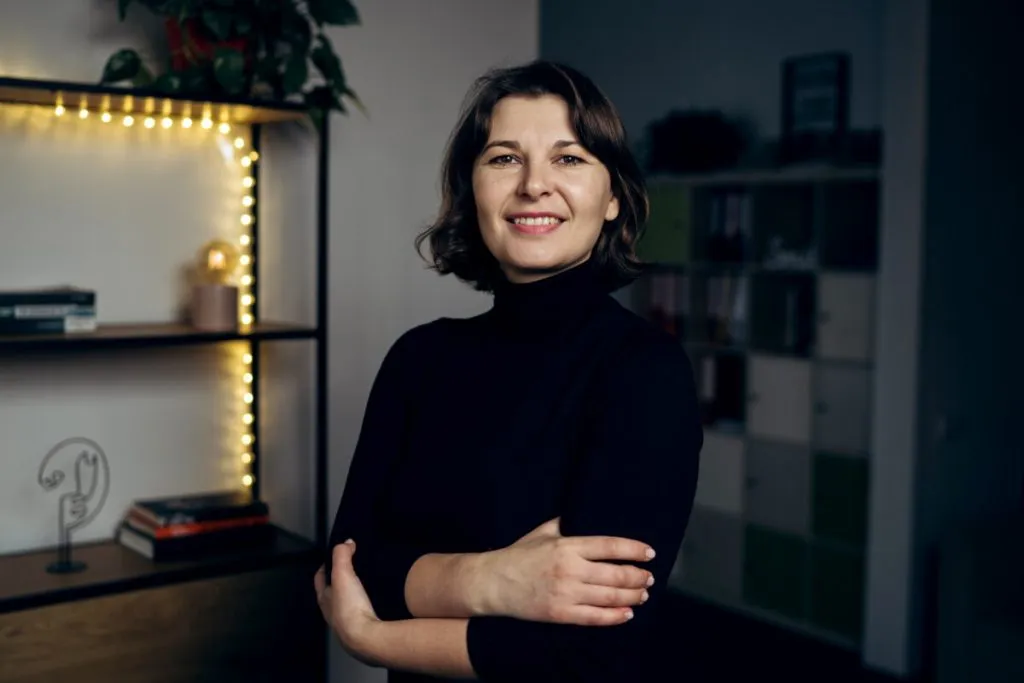
Daria Kaleniuk, co-founder of AntAC
“Zelensky is a very talented actor who senses his audience. But when he came to power he brought an image without substance. He filled that substance with people he trusted, some of whom were shady and some decent.
“The first half year of his presidency was promising, with the young reform-minded prime minister Oleksiy Honcharuk. A high court for corruption cases was created, parliament passed important anti-corruption laws. A reform-minded prosecutor-general and a good defence minister, Andriy Zahorodniuk, were appointed.
“Then something changed: Zelensky dismissed Bohdan as chief of staff and replaced him with Andriy Yermak. Many reformers were dismissed. That was the first wave of dismissals of people in top positions who had the right intentions and professionalism. The major change was that Yermak gained more influence and began shaping Zelensky’s future vision. Since then Zelensky and Yermak have been seen as two parts of one person.”
Austria is a safe haven for corrupt Ukrainian officials
An important problem, Kaleniuk says, is that Zelensky tolerates no other stars beside him.
I assume that is only your suspicion.
“That is a fact, not a suspicion. We have a lot of information. He allows no one, not even ministers, to make public statements or give interviews. Foreign Affairs was completely controlled by Yermak and Zelensky. Our foreign minister, Andriy Sybiha, is a professional, but he is not involved in the negotiations with Russia.
“Those negotiations are in the hands of non-professionals, incompetent people who are not trusted by the Ukrainian people, such as Davyd Arakhamia and Rustem Umerov, head of the national security council. Their names appear on NABU wiretaps, although they have not yet been charged with large-scale corruption.”
Arakhamia and Umerov hold high positions, and yet are amateurs?
“Amateurs with conflicts of interest. In Umerov’s case there are two aspects. First, his family lives in the United States: his wife and three children, his parents, and his brother with his family. They own luxury property in Miami. His brother runs a company there. You cannot expect someone with such interests in the United States to be immune to American pressures that could influence his positions.
Negotiations with Russia are in the hands of incompetent people
“Second, I think Umerov is afraid of investigation by NABU and SAPO. A recorded conversation exists between him and Tymur Mindich, Zelensky’s former business partner, about contracts with the defence company Fire Point, in which Mindich is a shareholder.”
In October, a bizarre incident occurred at the top of Ukrainian politics when Zelensky-appointed prosecutor-general Ruslan Kravchenko suddenly left the country. Shortly before, one of his employees was suspected by NABU of profiting from fraudulent call centres, a big business in Ukraine.
Kaleniuk is convinced that someone like Kravchenko could not flee without Zelensky or Arakhamia helping him. “I think he knows too much, and that is why they let him go,” she says. “If Kravchenko were prosecuted, he would probably have to cooperate with NABU and SAPO. Those organisations habitually reach settlements if lower officials can provide evidence against higher officials.”
It was the same Kravchenko who last summer stripped NABU and SAPO of their independence, and the same man who could block criminal prosecutions of Zelensky’s MPs.
When he came to power he brought an image without substance
Kravchenko is now in Austria. When award-winning investigative journalist Mykhailo Tkachenko went looking for him there, Tkachenko was removed from his car and detained by Austrian security services. Authorities later called it a mistake.
Kaleniuk believes otherwise. “It is a shame that Austria stays silent and gives no explanation. Austria is a safe haven for corrupt officials who fled Ukraine. More officials have moved to Austria and stayed there. The country should extradite them.”
The EU can play a key role in the fight against corruption, Kaleniuk stresses. “The European Commission is considering conditions for aid to Ukraine. All defence-related money is given without conditions. But there is also money reserved for macro-financial assistance. Clear, precise conditions must be attached to that money. A top priority should be the independent selection of the prosecutor-general.”



