
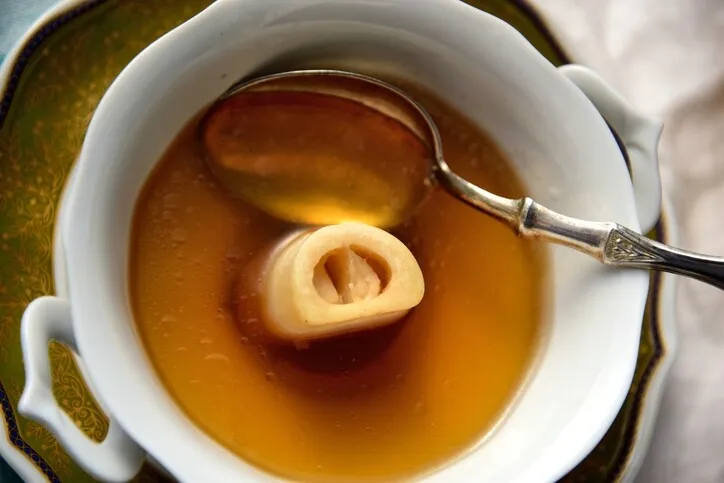
Influencers say it, so it must be true — right? As an ordinary citizen who likes to keep a clear head, I remain skeptical of these Hollywood-born health crazes. EW’s science editor Laurien Onderwater cheerfully dives into the curious world of online wellness fads and separates fact from fiction. This week: bone broth is claimed to be a source of collagen, amino acids and minerals. Does that automatically make it extremely healthy?
A little fact you probably didn’t ask for, but I start every day with a cappuccino. On an empty stomach. I enjoy it, it wakes me up and it’s become a morning ritual.
But according to health influencers and celebrities, I should ditch the coffee and begin the day with a steaming cup of bone broth.
Also read: Moet je ‘s winters extra vitamine D slikken? | Gezond verstand
The claim: bone broth supports many bodily functions
Bone broth is portrayed in the media as the cult wellness drink. It’s another one of those wellness fads exported from Hollywood, where the drink is called “bone broth.” Some well-known proponents of drinking bone broth include Gwyneth Paltrow, Kylie Jenner and Salma Hayek.
For example, in New York you can buy an overpriced takeaway cup of bone broth in many places. Many drink it as a coffee replacement. In the Netherlands you can also buy it widely: concentrated, powdered, or ready-made. Holland & Barrett, for instance, sells a 250-gram jar of bone broth powder for almost 25 euros.
The drink is made by simmering animal bones for several hours in a pot of water. Vegetables and spices are often added, and sometimes cartilage, skin and tendons too. The slow cooking process releases nutrients into the liquid, such as collagen, amino acids and minerals.
Those nutrients are precisely why many health benefits are claimed. There is a lot of attention around collagen (which I’ll look at more closely next week). Claims include better skin, more flexible joints and stronger bones.
Bone broth is also said to be good for the gut, the immune system and the metabolism. Finally, some claim drinking broth can improve sleep — but for that you’d have to take it just before bedtime, not in the morning as a coffee substitute.
Also read:Wat er écht nodig is voor sterk kraakbeen
The reality: bone broth is not a miracle cure
Scientists prefer nuance, and they are nuanced about this trend too. Drinking a cup of bone broth fits fine within a healthy, varied diet. Have it as a snack, by all means. But don’t expect miracles for your skin, joints, bones, gut, immune system or metabolism — the Dutch Nutrition Centre (Voedingscentrum) makes the same point.
To begin with, there’s no solid evidence that drinking bone broth firms the skin or prevents ageing. The other health claims are also hard to substantiate. Bone broth does contain amino acids such as glycine and glutamine, but it hasn’t been shown that the amounts in a cup of broth lead to better sleep, less inflammation or a stronger immune system.
There are minerals like calcium and magnesium, too, but in small amounts that provide less than 5 percent of the recommended daily intake. Protein content is limited as well.
Still, promoting bone broth is preferable to pushing the most bizarre wellness stunts. Madonna reportedly drank her own urine as part of a post-concert recovery ritual — something you probably didn’t want to know.
Also read:Kokoswater is opeens erg populair. Wat doet het voor je lijf? | Gezond verstand
Your science editor’s verdict on bone broth:
Drinking bone broth is harmless and can be part of a sensible diet, but it is not a miracle worker. Pay attention to the salt content, which is often high in ready-made cubes or powders.



