
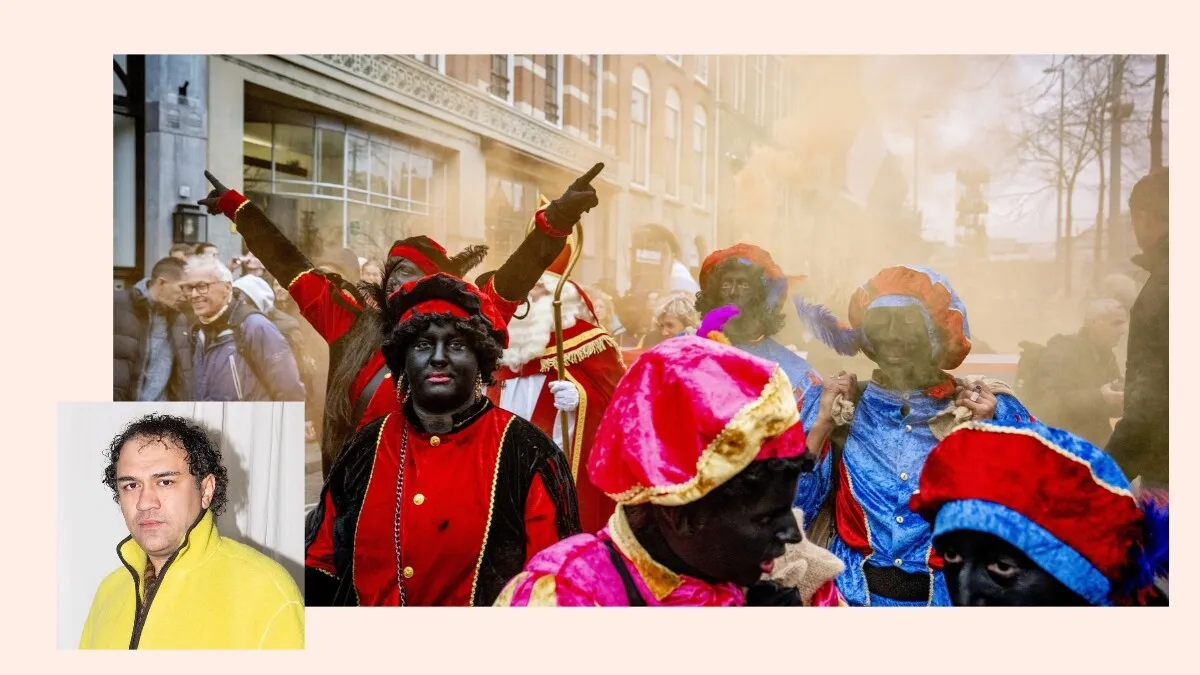
Many Dutch people accepted the soot-smudged Piet just to end the quarrel. Now, year after year, nostalgia for the old Piet grows. As a concerned citizen and patriot, I see this returning trend with little surprise.
First, a small, shameless but necessary bit of self-promotion. In my book Netherlands My Fatherland (2015) I wrote:
“On Facebook the professional activist had written: ‘Never bow to racists!’ In the clip he holds a sign against Black Pete. He argues with a woman. She looks terrified and shouts: ‘You’ve had enough. Why do you want to take this away from us too?’ This lady, the ‘racist’, is very elderly and literally standing behind a walker. It was incredibly sad to see that the professional activist didn’t understand how counterproductive his action was (…) The question now is to what extent the many mistakes of the professional activists have caused permanent damage (…) I suspect that in a few years every municipality will have its own version of Black Pete. Progressive municipalities will have a colour-Piet or no Piet at all. The rest of the Netherlands will make Piet even blacker.”
I don’t want to boast about being some kind of prophet for the Netherlands. Although… okay, just a little. More important is why such elementary common sense isn’t obvious in our country.
First the facts.
Last Saturday in Urk the Sinterklaas arrival was already over when a group of black-painted Piets set off heavy illegal fireworks. A fire started and the police intervened. The black Urk Piets were reportedly angry because the organisers had denied them access to the festivities.
On Sunday PVV member Martin Bosma posted the tally on X: ‘Netherlands – leftist elites 10-0’. The reason: a new poll shows 72 percent of Dutch households still say ‘Black Pete’.
Across the divide, victory has been proclaimed. The former leader of Kick Out Zwarte Piet (KOZP) claimed the end of Black Pete would be an ‘irreversible process’. On the surface that sounds plausible: since 2019 the national arrival and the Sinterklaas TV programme have only featured soot-smudged Piets.
But anyone who wants to know how many Dutch people truly support the change must look closely at the poll questions.
The TV programme EenVandaag asked in 2023 whether people found it acceptable that only soot-Piets took part in the national arrival: 54 percent thought that ‘fine’. When asked how Piet should look, 55 percent chose the traditional Black Piet. Only 32 percent wanted his appearance changed.
A year earlier EenVandaag explored why some fans of Black Piet could live with soot marks. Their main reason — and this is the unchallenged core of the matter — was that they were fed up with the debate and the protests. Such answers helped create ‘acceptance’: grudging resignation born from the desire for a quiet Saturday.
Some Dutch people did change their minds. In 2017 twelve percent of the EenVandaag panel saw Black Piet as a racist phenomenon, about twice as many as in 2014. And those who were once insulted as children for dressing as Black Piet have every right to ask what’s so merry about that tradition. That story deserves a conversation.
But at the arrival in a small town or village the message often landed like a foregone verdict. You came with your children to see Saint Nicholas and you could infer from the slogan ‘Black Piet is racism’ how the proverbial canal district thought about people like you.
In 2015 four subsidised buses from Amsterdam and Rotterdam drove to the arrival in Meppel. Amsterdam also funded projects by the related foundation Netherlands Gets Better, including the ‘Day of Empathy’. In Staphorst KOZP arranged transport after the municipality had rejected a bus request. There the demonstrators were attacked by local troublemakers. That violence is the responsibility of the perpetrators.
My objection to that form of protest remains: you turn a local arrival into a confrontation and then expect people along the route to quietly reconsider.
How durable was that victory over Black Piet, really? The TV show Hart van Nederland asks the same choice question every year. In 2023 sixty-two percent preferred the fully black-painted Piet over the soot-Piet. In 2025 that was sixty-four percent. This year it’s seventy-two percent. At the same time sixty-four percent still find the soot-Piet ‘acceptable’. That word says it all. Apparently the Netherlands has lived with soot marks for years while increasingly longing for the old Black Piet.
That surprises me hardly at all. Those who accept a compromise just to stop the fighting can revert once the dispute keeps clinging to that compromise. My forecast for the coming years: if this continues, Black Piet will return almost everywhere.
Browner than ever.



